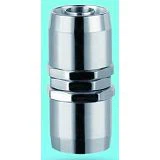
Hey there, racing enthusiasts and fuel system experts! I'm a supplier of Fuel Nozzle Couplings, and today I want to dig into a question that often comes up: Can a fuel nozzle coupling be used in a racing fuel system?
First off, let's understand what a fuel nozzle coupling is. It's a crucial part that connects the fuel nozzle to the fuel delivery hose. Its main job is to ensure a secure and leak - free connection between these two components. This is super important because any fuel leakage can be not only a waste but also a huge safety hazard.


Now, racing fuel systems have some unique requirements. In a race car, every single component needs to perform at its best. The fuel system has to deliver the right amount of fuel at the right pressure and flow rate to the engine constantly. The engine in a race car operates under extreme conditions - high speeds, rapid acceleration, and intense vibrations. So, the components in the fuel system need to be able to withstand these harsh environments.
One of the key advantages of using a high - quality fuel nozzle coupling in a racing fuel system is its ability to provide a reliable connection. A good coupling can prevent fuel leaks even when the car is going through sharp turns or experiencing heavy vibrations. This is essential for the safety of the driver and the performance of the vehicle. If there's a fuel leak, it can lead to a loss of power, and in the worst - case scenario, it can even cause a fire.
Another important aspect is the flexibility that a fuel nozzle coupling can offer. Some couplings come with features like Fuel Nozzle Swivel Joint. These swivel joints allow the fuel nozzle to move freely in different directions. In a race car, the fueling process needs to be quick and efficient. A swivel joint can make it easier to position the fuel nozzle correctly during refueling, which can save valuable seconds during a pit stop.
Multi Plane Swivel is another great option. It provides even more flexibility than a regular swivel joint. It can rotate in multiple planes, which is extremely useful when the fuel tank opening is in an awkward position. This kind of flexibility can make the refueling process much smoother and faster, giving the race team a competitive edge.
The material of the fuel nozzle coupling is also a critical factor. In a racing fuel system, the coupling needs to be made of materials that can resist corrosion and high - pressure conditions. Most high - end fuel nozzle couplings are made of stainless steel or other high - strength alloys. These materials are not only durable but also lightweight, which is a big plus in a race car where every extra pound can slow down the vehicle.
However, there are also some potential challenges when using a fuel nozzle coupling in a racing fuel system. One of the main concerns is the compatibility with other components in the fuel system. The coupling needs to be able to work seamlessly with the fuel pump, the fuel lines, and the fuel tank. If there's a mismatch in terms of size, pressure rating, or flow rate, it can cause problems such as reduced fuel flow or even damage to the components.
Another challenge is the maintenance. In a racing environment, time is of the essence. The fuel nozzle coupling needs to be easy to maintain and replace. If it's too complicated to disassemble and clean, it can take up too much time during pit stops and maintenance periods. That's why it's important to choose a coupling that is designed for easy maintenance.
When it comes to pressure handling, racing fuel systems often operate at much higher pressures compared to regular vehicles. A fuel nozzle coupling used in a racing fuel system needs to be able to handle these high - pressure conditions without failure. This means that the coupling has to be carefully engineered and tested to ensure it can withstand the extreme pressures.
Now, let's talk about the Hose Connection Coupling. This type of coupling is specifically designed to connect the fuel hose to other components in the fuel system. It's important to choose a hose connection coupling that is compatible with the type of hose used in the racing fuel system. Different hoses have different inner diameters, wall thicknesses, and pressure ratings, so the coupling needs to match these specifications.
In addition to the technical aspects, cost is also a factor to consider. High - performance fuel nozzle couplings and related components can be expensive. However, in the world of racing, where every small improvement can make a big difference, the additional cost may be worth it if it can improve the performance and safety of the vehicle.
So, can a fuel nozzle coupling be used in a racing fuel system? The answer is yes, but with some considerations. As a supplier, I can provide high - quality fuel nozzle couplings that are designed to meet the demanding requirements of racing fuel systems. Our products are made of top - notch materials, carefully engineered, and rigorously tested to ensure reliability, flexibility, and high - pressure resistance.
If you're looking for a fuel nozzle coupling or other related components for your racing fuel system, don't hesitate to reach out. We're here to help you find the perfect solution for your needs. Whether you're a professional racing team or an amateur racer, we can provide the products and support you need to keep your race car running at its best. Let's start a conversation and see how we can work together to enhance your racing experience.
References
- Industry standards for racing fuel systems.
- Technical specifications of fuel nozzle couplings.