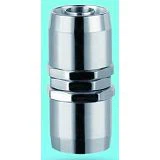
How to Adjust the Tightness of a Hose Connection Coupling
As a supplier of Hose Connection Couplings, I understand the importance of ensuring a proper and secure connection. Adjusting the tightness of a hose connection coupling is a crucial step in maintaining the integrity and functionality of the entire system. In this blog post, I will share some essential tips and techniques on how to adjust the tightness of a hose connection coupling effectively.
Understanding the Basics of Hose Connection Couplings
Before we dive into the adjustment process, it's essential to have a basic understanding of hose connection couplings. These couplings are used to connect two hoses or a hose to a fitting, creating a secure and leak - proof connection. There are various types of hose connection couplings, including threaded couplings, quick - connect couplings, and compression couplings, each with its own unique characteristics and adjustment methods.
Threaded couplings are perhaps the most common type. They rely on the threading on the coupling and the fitting to create a tight seal. Quick - connect couplings, on the other hand, allow for rapid connection and disconnection, often using a locking mechanism. Compression couplings use a compression ring to create a seal when tightened.
Tools Required for Adjusting Hose Connection Couplings
To adjust the tightness of a hose connection coupling, you will need a few basic tools:
- Wrenches: Depending on the size and type of the coupling, you may need an adjustable wrench, a pipe wrench, or a socket wrench. For smaller couplings, an adjustable wrench is usually sufficient, while larger couplings may require a pipe wrench.
- Sealant: In some cases, using a sealant can help improve the tightness and prevent leaks. There are different types of sealants available, such as Teflon tape or pipe dope.
Step - by - Step Guide to Adjusting the Tightness
- Inspect the Coupling and Hose
- Before making any adjustments, carefully inspect the coupling and the hose for any signs of damage, such as cracks, cuts, or wear. If there is any damage, it's important to replace the damaged parts before proceeding.
- Check the threads on the coupling and the fitting. Make sure they are clean and free of debris. If the threads are dirty, use a wire brush to clean them.
- Apply Sealant (if necessary)
- If you are using a threaded coupling, apply a thin layer of Teflon tape or pipe dope to the male threads. Wrap the Teflon tape in the direction of the threads, starting from the end of the male threads. For pipe dope, apply it evenly to the male threads.
- Connect the Coupling
- For threaded couplings, hand - tighten the coupling onto the fitting. Make sure it is aligned correctly and starts threading smoothly. Avoid cross - threading, as this can damage the threads and prevent a proper seal.
- If you are using a quick - connect coupling, follow the manufacturer's instructions to connect the coupling. Usually, this involves inserting the hose into the coupling and locking it in place.
- For compression couplings, insert the hose into the coupling and then tighten the compression nut using a wrench.
- Tighten the Coupling
- Use the appropriate wrench to tighten the coupling further. For threaded couplings, turn the coupling clockwise to tighten it. Be careful not to over - tighten, as this can damage the threads or the coupling itself.
- As a general rule, for most threaded couplings, you can start with a few turns after hand - tightening. If you are using a compression coupling, tighten the compression nut until it is snug, but again, avoid over - tightening.
- Check for Leaks
- Once the coupling is tightened, turn on the fluid flow (if applicable) and check for any leaks. Look for any signs of dripping or spraying around the coupling. If you detect a leak, you may need to tighten the coupling a little more. However, if the leak persists, it could be due to a damaged seal or improper installation.
Common Mistakes to Avoid
- Over - tightening: Over - tightening a coupling can lead to damaged threads, cracked couplings, or even a burst hose. It's important to find the right balance between a tight connection and avoiding excessive force.
- Under - tightening: An under - tightened coupling can result in leaks, which can be a safety hazard, especially in applications involving flammable or toxic fluids.
- Using the wrong tools: Using the wrong size or type of wrench can make it difficult to adjust the coupling properly and may cause damage to the coupling or the fitting.
Advanced Tips for Specific Applications
In some specialized applications, such as in the fuel industry, the adjustment of hose connection couplings becomes even more critical. For example, in fuel transfer systems, the tightness of the coupling can affect the safety and efficiency of the operation.
If you are dealing with fuel hoses, you may be interested in our New Type Of Intermediate Joint, Fuel Nozzle Swivel Joint, and Universal Joint for Fuel Hose Nozzle. These products are designed to provide a secure and reliable connection in fuel transfer applications.
When adjusting couplings in fuel systems, it's important to follow strict safety protocols. Make sure the system is depressurized before making any adjustments. Also, use appropriate sealants that are compatible with the fuel being transferred.
Conclusion
Adjusting the tightness of a hose connection coupling is a simple yet crucial task that can ensure the proper functioning and safety of your hose system. By following the steps outlined in this blog post and avoiding common mistakes, you can achieve a secure and leak - proof connection.
If you are in the market for high - quality Hose Connection Couplings or have any questions about adjusting them, we are here to help. Our team of experts can provide you with the right products and advice to meet your specific needs. Contact us to start a procurement discussion and find the best solutions for your hose connection requirements.


References
- "Hose Fittings and Couplings Handbook" by Industrial Press Inc.
- Manufacturer's manuals for various hose connection coupling products.